Progress of the National Land Satellite Initiative
- The development of the CAS500 series was initiated with the goal of independently developing satellites to meet national satellite demands.
- Satellite development aims to address public needs and establish a foundation for the space industry.
- Out of 40 surveyed satellite demands, a final selection of 12 satellites was made, including two National Land Satellites.
- In 2021, CAS500-1 (National Land Satellite 1) was successfully developed and launched.
- In 2026, CAS500-2 (National Land Satelite 2) was successfully launched.
Mission of the National Land Satellites (CAS500-1 and 2)
- Land surface observations for land and natural resource management, disaster monitoring, and spatial information acquisition.
- Addressing the public sector's needs for satellite images and contributing to their effective utilization.
Figure and specifications of CAS500
 Figure of CAS500-1
| Orbit | Sun-synchronous orbit (500㎞) |
|---|---|
| Spectral bands |
MS (4 bands) : 450-900 ㎚ (Blue, Green, Red, and NIR) Pan : 450-900 ㎚ |
| Spatial resolution (@nadir) |
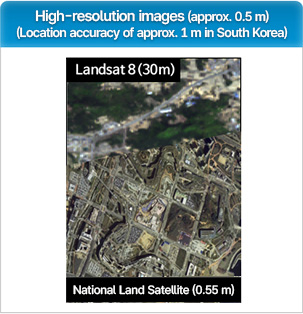
MS ≤ 2.0m
Pan ≤ 0.5m |
| Swath (@nadir) | ≥ 12㎞ |
| Radiometric resolution | 12 bits/pixel |
| Mission duration | ≥ 4 years |
Satellite observations of the Korean Peninsula
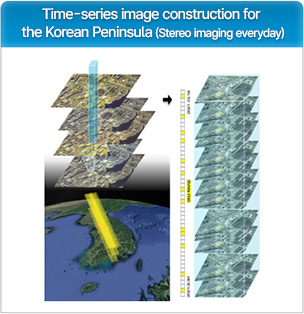
- Daily observation planning to achieve the main missions
- Land surface observations within the operational range (±56˚ for roll tilt and ±30˚ for pitch tilt)
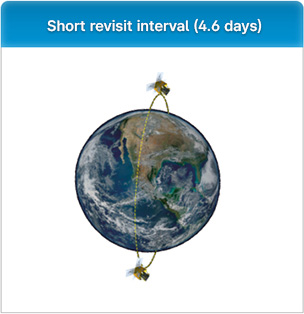
- 16.5 observations per month over the Korean Peninsula (depending on meteorological conditions)
Launch Process of the CAS500-1
- Development and Specifications
-
Jointly developed by the Ministry of Land, Infrastructure and Transport (MOLIT) and the Ministry of Science and ICT (MSIT), with the Korea Aerospace Research Institute (KARI) leading the project.
Satellite bus: Developed as Korea’s first standardized satellite.
Payload: Equipped with a high-resolution (50 cm) electro-optical camera primarily for land observation.
Launch vehicle: Russian Soyuz 2.1a rocket.
- Launch Schedule and Location
-
Launch date: March 22, 2021
Launch site: Baikonur Cosmodrome, Kazakhstan
- Introductory Video for Launch Success
Launch Process of the CAS500-2
- Development and Specifications
-
Transitioned from the Korea Aerospace Research Institute (KARI) to Korea Aerospace Industries (KAI) for production under a commercial mass-production system.
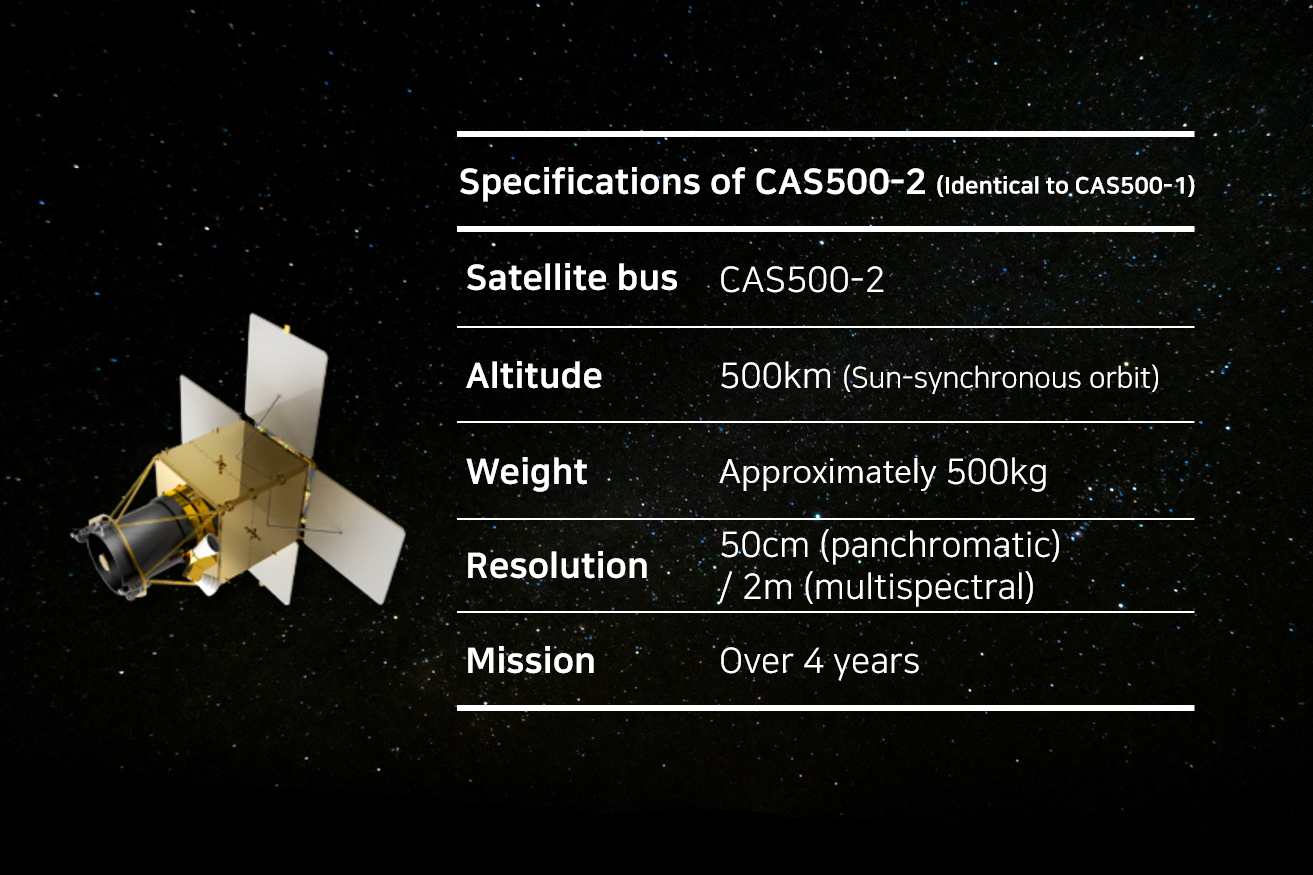
Satellite bus and payload: Identical to CAS500-1.
Launch vehicle: SpaceX Falcon 9 rocket (USA).
- Current Launch Progress
-
2017: Signed a launch contract for CAS500-2 using the Russian Soyuz-2 launch vehicle.
2022: Temporary suspension due to the Russia-Ukraine war.
2023: Terminated the existing contract and signed a new joint launch contract with SpaceX for CAS500-2 and 4 (Agriculture and Forest Satellite).
- Launch Schedule and Location
-
Launch date: May 3, 2026
Launch site: Vandenberg Space Force Base, California, USA
Specifications of CAS500-2
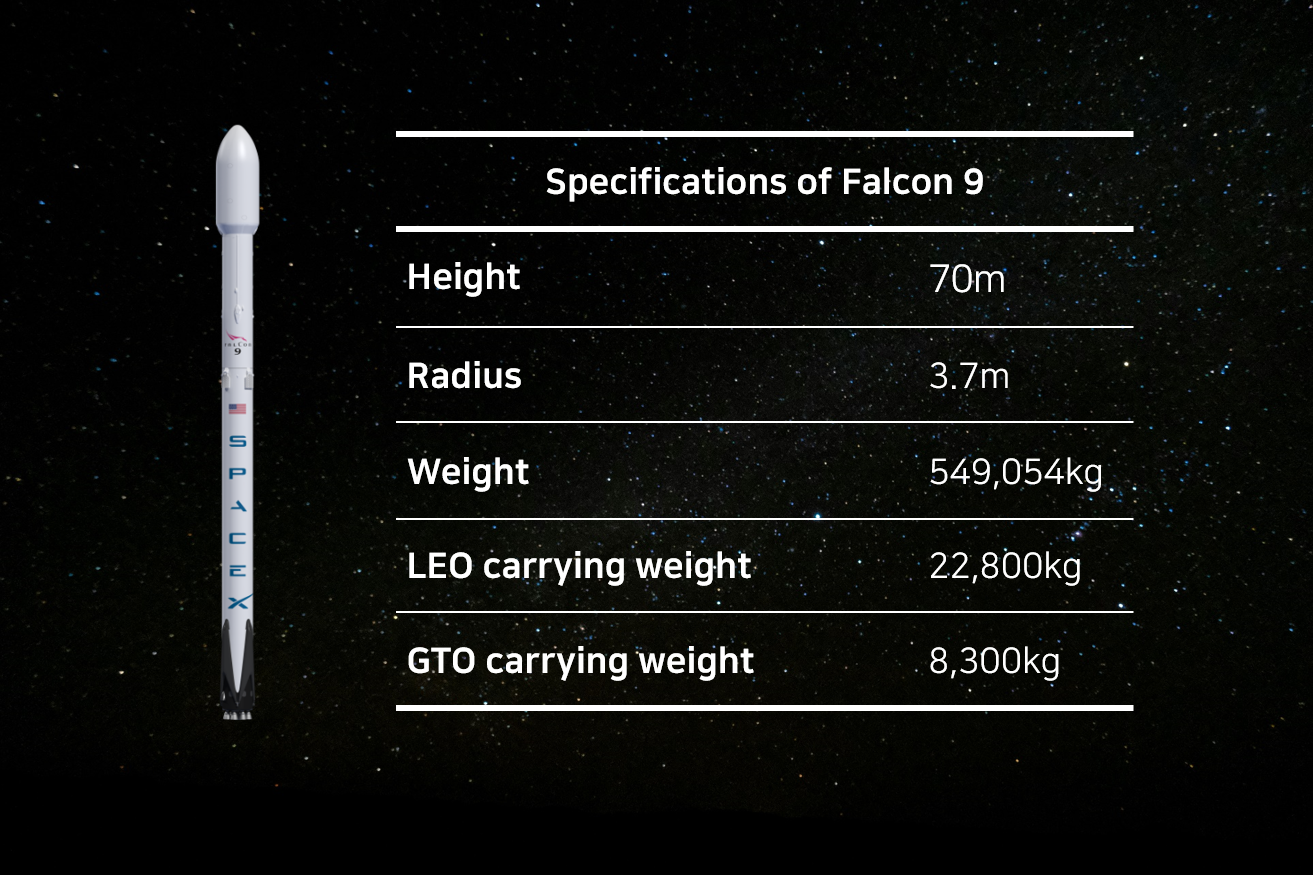
Specifications of Falcon 9